- Name: isa – ice
- Sound: i (as ee in deed)
- Ætt: Hagal’s ætt, 3rd rune
- Keywords: unity, stillness, concentration, contraction, ego
The Name
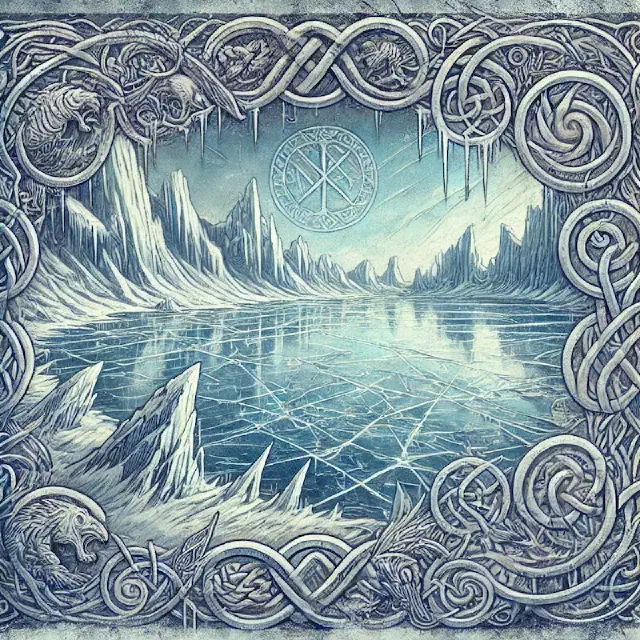
The Proto-Germanic isa means ice, and the word barely changes in the daughter languages: Gothic eis, Old English is, Old Norse íss. The stave is a single straight line, read as an icicle or as the stream of ice that flowed out of Niflheimr, the cold world, at the beginning of things.
In the old cosmology ice meets fire, and from their meeting the world is made. Isa is the cold, contracting pole of that pair; Fehu, the fiery rune that opens the row, is its opposite.
The Rune Poems
All three poems describe ice as beautiful and useful but treacherous: it shines, it can be walked on, and it can kill.
Old English Rune Poem (8th–9th century)
Is byþ oferceald, ungemetum slidor,
glisnaþ glæshluttur gimmum gelicust,
flor forste geworuht, fæger ansyne.Ice is bitterly cold and slippery past measure;
it gleams glass-clear, most like jewels,
a floor fashioned by frost, lovely to look at.
Old Norwegian Rune Rhyme (12th–13th century)
Ís kǫllum brú bræiða;
blindan þarf at læiða.Ice we name the wide bridge;
the blind man needs leading.
Old Icelandic Rune Poem (15th century)
Íss er árbörkr
ok unnar þak
ok feigra manna fár.
glacies – jöfurrIce is river-bark,
and the roof of the waves,
and a peril for men marked to die.
ice – lord
“River-bark” and “roof of the waves” are kennings for the ice that covers water. The Norwegian “wide bridge” is the same frozen surface you can cross on foot; the second line warns that such a crossing needs a guide. Thorsson reads Isa as the bridge consciousness uses to pass between worlds, a solid floor that is sometimes only as wide as a hair.
Meaning
Isa is unity: contraction, concentration and stillness. It is the force that pulls inward and holds things together. In a person it is the ego in the plain sense—the “I” that keeps the whole self in one piece, especially through hard trials. Its gift is quiet: a mind that is still and gathered.
Any process can slow down or stop under Isa, and that can be good or bad. Held in balance with the moving runes, the stillness gives focus and self-control. Left on its own, it turns into rigidity and dullness, and the person who is frozen cannot see where they are going.
- In balance: a concentrated self, awareness, self-control, unity
- Out of balance: egocentrism, dullness, blindness, loss of energy
Galdr
Galdr is the sung or chanted form of a rune. A traditional pattern for Isa, sung slowly on one long breath per line:
isa isa isa
iiiiiiiiii
iiiiisssss
(sssss iiiii)
iiiiiiiiii
The classic stadha (static rune posture) for Isa is the simplest of all: stand upright with your arms pressed tight against your sides, the whole body a single straight line. A second form raises both arms straight overhead with the palms touching. The Dynamic Stance of Isa turns this shape into a flowing movement.
Related Runes
- Fehu – the fire to Isa’s ice; the two are the opposite poles from which the world is formed.
- Sowilo – the sun is the counterweight to Isa’s inertia; both are needed for a stable whole.
- Hagalaz – Isa draws fire inward to a centre and so forms the hailstone.