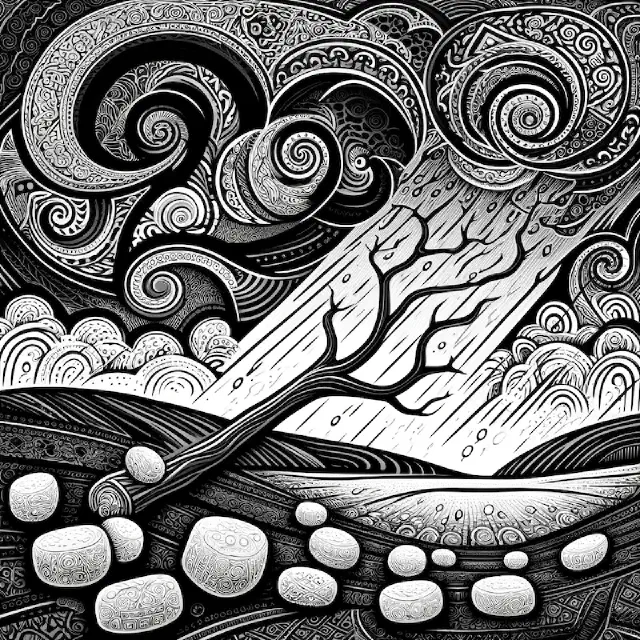
- Name: hagalaz – hail, hailstone
- Sound: h
- Ætt: Hagal’s ætt, 1st rune
- Keywords: sudden change, crisis, natural forces, pattern, completion
The Name
The Proto-Germanic hagalaz means hail. The word is the same in all the daughter languages: Gothic hagl, Old English hægl, Old Norse hagall. Thorsson adds a possible second sense, “egg”, and reads the hailstone as an icy seed that holds the pattern of what will grow from it.
Hagalaz opens the second ætt, which takes its name from this rune. It is the ninth rune of the row, and nine is the number of completion in Germanic lore: nine worlds in the World-Tree, nine nights that Odin hung on it to win the runes.
The Rune Poems
All three poems describe hail as a kind of grain: something cold and hard that falls from the sky, does damage, and melts away.
Old English Rune Poem (8th–9th century)
Hægl byþ hwitust corna; hwyrft hit of heofones lyfte,
wealcaþ hit windes scura; weorþeþ hit to wætere syððan.Hail is the whitest of grain; it whirls from the air of heaven,
gusts of wind toss it about; then it becomes water.
Old Norwegian Rune Rhyme (12th–13th century)
Hagall er kaldastr korna;
Kristr skóp hæimenn forna.Hail is the coldest of grain;
Christ made the world long ago.
Old Icelandic Rune Poem (15th century)
Hagall er kaldakorn
ok krapadrífa
ok snáka sótt.
grando – hildingrHail is cold grain,
and a flurry of sleet,
and a sickness to snakes.
hail – war-chief
Calling hail a “grain” is the key image: it falls like seed, yet it ruins the crop. The “sickness of snakes” is a riddle for cold that destroys. The line about Christ in the Norwegian stanza is one of the Christian touches in that poem; it still pairs hail with the making of the world, which is close to how Thorsson reads the rune.
Meaning
Hagalaz is sudden change: crisis, a storm from outside, natural forces beyond our control. Hail can flatten a field in minutes. Sometimes that clearing is needed, because space has to be made before something new can grow.
There is a second layer under the destruction. In the lore the hailstone joins fire and ice, the two first powers of the world, and holds the complete pattern of what comes after. Thorsson calls Hagalaz the “mother rune”: all the other staves can be drawn from its six-armed form. What looks like breakdown is also the seed of a new order and a kind of completion.
- In balance: change that goes where you intend, a crisis kept under control, completion, inner harmony
- Out of balance: catastrophe, crisis, stagnation, loss of power
Galdr
Galdr is the sung or chanted form of a rune. A traditional pattern for Hagalaz, sung slowly on one long breath per line:
hagalaz hagalaz hagalaz
h h h h h h h h h h
hu ha hi he ho
hug hag hig heg hog
(hul hal hil hel hol)
oh eh ih ah uh
h h h h h h h h h h
The classic stadha (static rune posture) for Hagalaz is the cross position: stand upright with both arms stretched out to the sides, level with the ground, palms facing outward. Thorsson also builds a longer exercise on this stance, turning to all four directions on each breath. The Dynamic Stance of Hagalaz turns this shape into a flowing movement.
Related Runes
- Isa – the ice that draws fire to a centre and so forms the hailstone; Hagalaz holds fire and ice together.