- Name: nauthiz – need, distress, constraint
- Sound: n
- Ætt: Hagal’s ætt, 2nd rune
- Keywords: need, resistance, trial, need-fire, innovation
The Name
The Proto-Germanic nauthiz meant need, with a shade of compulsion that cannot be avoided. The cognates keep both sides of it: Gothic nauths, necessity; Old English nyd, need or distress; Old Norse nauðr, distress, constraint, and even bondage or fetters.
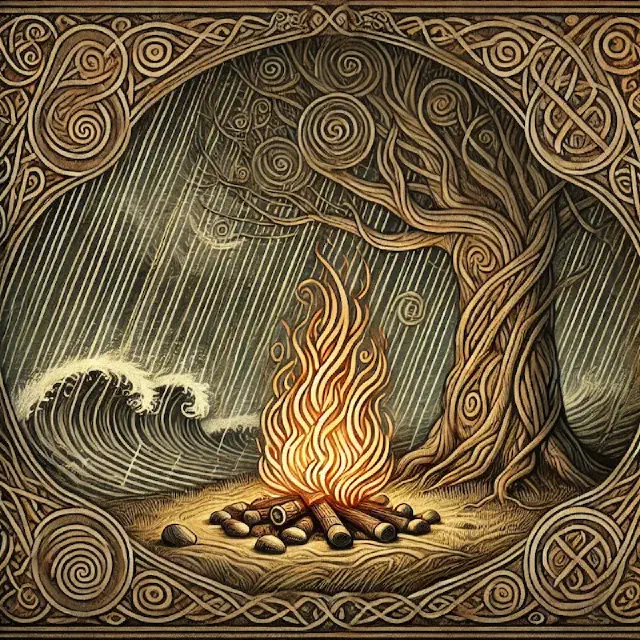
Thorsson reads the stave as an upright bore and the slanting bow that turns it to kindle the need-fire: fire made by friction between two lifeless materials.
The Rune Poems
All three poems speak of need as hardship. Only the Old English one adds that need, heeded in time, can turn into help.
Old English Rune Poem (8th–9th century)
Nyd byþ nearu on breostan; weorþeþ hi þeah oft niþa bearnum
to helpe and to hæle gehwæþre, gif hi his hlystaþ æror.Need is a narrowness in the breast; yet for people it often becomes
both a help and a healing, if they listen to it early on.
Old Norwegian Rune Rhyme (12th–13th century)
Nauðr gerer næppa koste;
nøktan kælr í froste.Need leaves a narrow choice;
the naked one is chilled by frost.
Old Icelandic Rune Poem (15th century)
Nauð er Þýjar þrá
ok þungr kostr
ok vássamlig verk.
opera – niflungrNeed is the bondwoman’s longing,
and a heavy lot,
and toil in cold and wet.
labours – prince
The Norwegian couplet shows need at its barest: without clothing, frost gets straight through. The Icelandic lines give three faces of constraint—an unfree woman’s longing, a hard situation, and work that wears you down. The Old English stanza alone holds the turn that matters for runework: the same pressure can become a remedy.
Meaning
Nauthiz covers the basic needs of every living being, what is required just to survive. Only when these are met can a person turn to other aims, the spiritual among them. When they are not met, need presses on the chest and narrows every choice.
The deeper teaching is resistance. Fire made by friction comes from two things working against each other, and in the same way inner tension can be turned into strength. Necessity is the mother of invention: without need, the fire would never have been found. Thorsson also ties this rune to the Norns, the shapers of fate. Need is the friction through which cause and effect work, and a person who meets it with knowledge and will can use their fate instead of struggling against it.
- In balance: resistance that builds strength, recognising one’s fate, innovation, self-reliance
- Out of balance: loss of freedom, want, drudgery, neglect
Galdr
Galdr is the sung or chanted form of a rune. A traditional pattern for Nauthiz (in Thorsson’s spelling naudhiz), sung slowly on one long breath per line:
naudhiz naudhiz naudhiz
nnnnnnnnnn
nu na ni ne no
nudh nadh nidh nedh nodh
(nut nat nit net not)
un an in en on
nnnnnnnnnn
The classic stadha (static rune posture) for Nauthiz has you standing upright with the right arm raised out to the side and the left arm slanting down, so that both arms form one straight diagonal line across the upright body, like the crossbar of the stave. The Dynamic Stance of Nauthiz turns this shape into a flowing movement.
Related Runes
- Perthro – the rune of the Norns and of fate; Nauthiz is the resistance their law needs in order to work.
- Kenaz – Thorsson sees the inner fire as kindled by Nauthiz and made manifest in Kenaz, the rune of controlled fire.