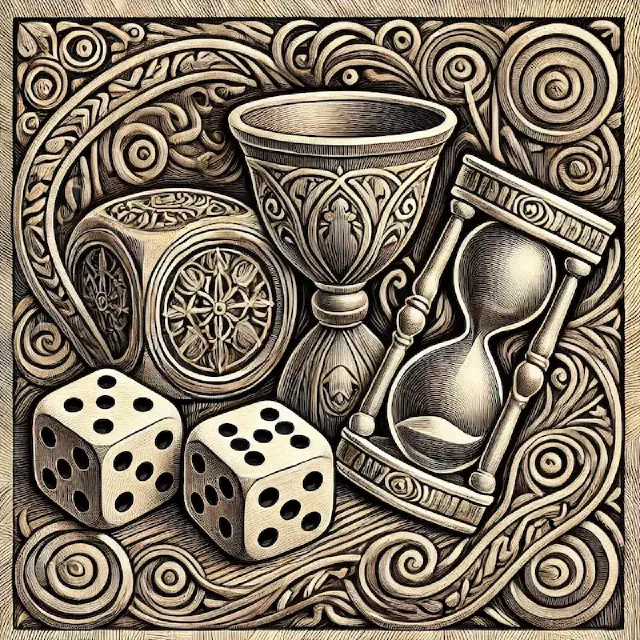
- Name: perthro – lot cup, device for casting lots
- Sound: p
- Ætt: Hagal’s ætt, 6th rune
- Keywords: fate, chance, synchronicity, cause and effect, divination
The Name
Thorsson explains the Proto-Germanic perthro as a device for casting lots. He gives Gothic pairthra, dice cup, and Old English peorð, whose meaning is uncertain—perhaps a gaming piece. The rune has no place in the Younger Futhark, so there is no Old Norse name.
The stave is read as the cup from which, or into which, lots are cast. Thorsson links it to the Well of Urðr, named after the first and eldest of the Norns.
The Rune Poems
Only the Old English poem has a stanza for Perthro; the rune is missing from the younger row that the Norse poems follow.
Old English Rune Poem (8th–9th century)
Peorð byþ symble plega and hlehter
wlancum [on middum], ðar wigan sittaþ
on beorsele bliþe ætsomne.Peorth is ever play and laughter
to the proud [among them], where warriors sit
cheerful together in the beer-hall.
The stanza shows a game in the hall—dice, lots or a board game—without saying what peorð actually is. The words in brackets are a later editor’s addition to fill a gap in the line. Thorsson reads the rune through that same casting of lots, used for divination.
Meaning
Perthro is fate, but not in the sense of a fixed future. The Norse word ørlög means “primal layers”: the layers of past action, by gods and people, that shape what can happen next. The three Norns name the pattern—Urðr, “what has become”; Verðandi, “what is becoming”; and Skuld, “what should become”. Only the past and present are settled; the future is open.
So Perthro joins cause and effect with chance and synchronicity, the meaningful coincidence of things that happen together. We do not know what is going to happen, but we do choose what to do in this moment. Casting the runes is a way to read the layers already laid down; the dísir, the guiding spirits, help on the paths of this web.
- In balance: a good lot, knowledge of one’s fate, friendship and joy, change that leads to growth
- Out of balance: dependence, stagnation, loneliness, trouble
Galdr
Galdr is the sung or chanted form of a rune. A traditional pattern for Perthro, sung slowly on one long breath per line:
perthro perthro perthro
pu pa pi pe po
purdh pardh pirdh perdh pordh
po pe pi pa pu
peeeerrrrththththrrrroooo
The classic stadha (static rune posture) for Perthro is a seated one: sit on the ground with the back straight, knees drawn up and feet flat, and rest the elbows on the knees with the forearms slanting forward, facing west. The body takes the shape of the stave. The Dynamic Stance of Perthro turns this shape into a flowing movement.
Related Runes
- Nauthiz – the resistance the Norns need for their law of cause and effect to work.
- Berkana – together with Nauthiz, Perthro is a main agent of change and becoming in the world.
- Elhaz – shares a spiritual nature with Perthro and Eihwaz, its neighbours in the row.