- Name: elhaz / algiz – elk; protection
- Sound: final -z (later -R)
- Ætt: Hagal’s ætt, 7th rune
- Keywords: protection, connection with the gods, awareness, sanctuary
The Name
The rune has two Proto-Germanic names: elhaz, elk, and algiz, protection. Old English eolh means elk; the Gothic algis may mean swan. Thorsson also relates Gothic alhs, a sanctuary or holy grove, and the Alcis, divine twins named by Tacitus. Its sound was a z at the end of words, which later became the final r of Old Norse.
The shape is read as a splayed hand raised in defence, the antlers of the elk, a swan in flight, or the branches of a tree. It is also the old Germanic posture of prayer, both arms lifted. In the Younger Futhark this form became the rune maðr, “man”, while an upside-down variant, ᛦ, became the yew-rune ýr.
The Rune Poems
Only the Old English poem has a stanza for Elhaz. The Norse poems have none: the younger rune ýr took over Elhaz’s sound and a variant of its shape, but its stanzas speak of the yew and the bow, so they are given on the Eihwaz page.
Old English Rune Poem (8th–9th century)
Eolh-secg eard hæfþ oftust on fenne
wexeð on wature, wundaþ grimme,
blode breneð beorna gehwylcne
ðe him ænigne onfeng gedeþ.Elk-sedge most often lives in the fen;
it grows in the water and wounds grievously,
it brands with blood every man
who lays any hand on it.
Eolh-secg, “elk-sedge”, is a sharp-edged marsh grass that cuts the hand that grabs it. Thorsson takes it as a hidden name for the sword, and points to the link between horn and sword in the myth of Freyr, who was left with only a horn to fight with after giving away his sword. The protection of Elhaz is not soft: it wounds whoever seizes it the wrong way.
Meaning
Elhaz is protection—the kind that comes from a link with the divine. It is the rune of perception of and communication with the gods and mythic states, the force that draws a person’s awareness toward the realm of the Æsir. In the lore this link is the valkyrja, the protective spirit attached to a person, and the rainbow bridge Bifröst, which joins Midgard to the worlds above and below.
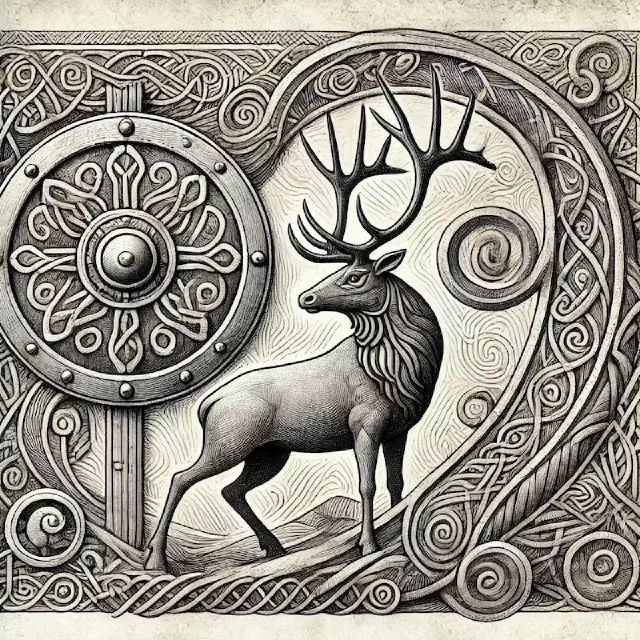
The elk stands for strength, stamina and spiritual protection. Elhaz shares a spiritual nature with its neighbours Eihwaz and Perthro. A person or place loaded with this force becomes sacred, set apart and guarded.
- In balance: connection with the gods, awakening, a higher life, protection
- Out of balance: hidden danger, being consumed by divine forces, losing the connection with the divine
Galdr
Galdr is the sung or chanted form of a rune. A traditional pattern for Elhaz, sung slowly on one long breath per line (the z is a deep, whirring, whistling sound):
elhaz elhaz elhaz
z z z z z z z z z z
uz az iz ez oz
oz ez iz az uz
zzzzzzzzzz
(mmmmmmmmmm)
The classic stadha (static rune posture) for Elhaz has you standing upright with both arms stretched up and out to the sides, the old posture for calling on the gods. Thorsson also gives the same arm position while kneeling, sitting back on the heels, or with one knee on the ground. The Dynamic Stance of Elhaz turns this shape into a flowing movement.
Related Runes
- Eihwaz – the yew runs through both runes’ lore, and the younger yew-rune ýr grew out of Elhaz’s shape.
- Sowilo – the pull of Elhaz toward the divine self works together with Sowilo to form the magical will.