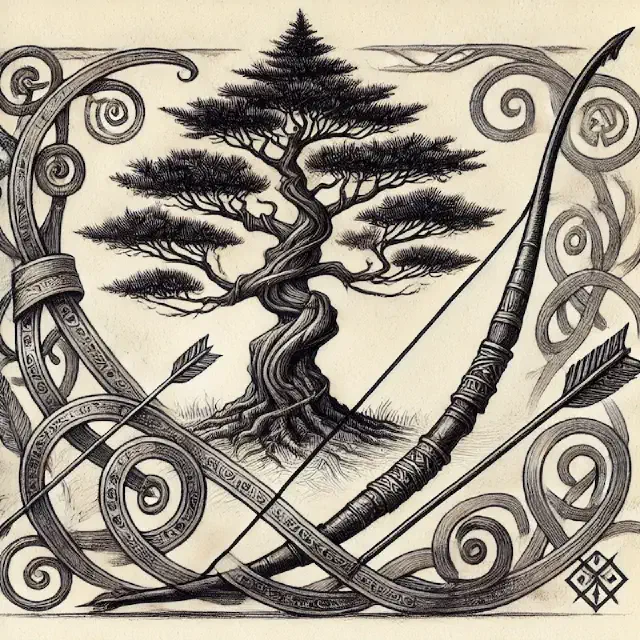
- Name: eihwaz – yew tree
- Sound: uncertain, somewhere between e and i
- Ætt: Hagal’s ætt, 5th rune
- Keywords: death and life, the world axis, endurance, initiation, protection
The Name
The Proto-Germanic eihwaz (also iwaz) means the yew tree: Gothic eihwas, Old English eoh. In Old Norse the elder rune name survives only in runic inscriptions; the Younger Futhark has no Eihwaz, but its rune ýr, “yew” or “bow of yew wood”, carries the yew forward. The rune was rarely used to spell words, and its exact sound is uncertain.
The yew is evergreen, very long-lived, hard and flexible enough for bows, and poisonous. It is often found in old churchyards, and it holds both death and lasting life. Thorsson argues that the World-Tree, Yggdrasill, was in most cases thought of as an evergreen yew rather than an ash, and reads the stave as the tree’s vertical trunk.
The Rune Poems
Only the Old English poem has a stanza for Eihwaz itself. The two Norse poems were written for the sixteen-rune Younger Futhark; their stanzas for the younger rune ýr (yew) are given below because they speak of the same tree.
Old English Rune Poem (8th–9th century)
Eoh byþ utan unsmeþe treow,
heard hrusan fæst, hyrde fyres,
wyrtrumun underwreþyd, wyn on eþle.Yew is a tree with rough bark outside,
hard and fixed in the ground, guardian of fire,
held up beneath by its roots, a joy in the homeland.
Old Norwegian Rune Rhyme (12th–13th century), stanza for the younger rune ýr
Ýr er vetrgrønstr viða;
vænt er, er brennr, at sviða.Yew is the greenest wood in winter;
when it burns, it is apt to scorch.
Old Icelandic Rune Poem (15th century), stanza for the younger rune ýr
Ýr er bendr bogi
ok brotgjarnt járn
ok fífu fárbauti.
arcus – ynglingrYew is a bent bow,
and brittle iron,
and the Fárbauti of the arrow.
bow – prince
The “guardian of fire” and the Norwegian line about scorching both tie the yew to fire: its wood burns hot, and Thorsson reads the rune as a fire hidden inside. Fárbauti is the name of a giant; “the arrow’s Fárbauti” is a kenning for the bow that sends the arrow on its way. The Icelandic manuscripts differ in the second and third lines.
Meaning
Eihwaz is the axis: the trunk of the World-Tree that runs through the three realms—the heavens, middle-earth and the underworld—and connects them. On this tree Odin hung to win the runes, and along its trunk the rune-worker fares down to the realm of the dead and on to all nine worlds to gain their wisdom. The rune touches the mysteries of death, and it is a channel to other worlds.
Because it unites death and life, Eihwaz is also the hidden fire of the will that stays alive through winter: the hard, patient spirit of perseverance. The yew is a tree of protection too; an old German saying holds that no evil magic can remain before the yews.
- In balance: enlightenment, resilience, initiation, protection
- Out of balance: confusion, destruction, dissatisfaction, weakness
Galdr
Galdr is the sung or chanted form of a rune. A traditional pattern for Eihwaz, sung slowly on one long breath per line (the e is a neutral, closed vowel):
eihwaz eihwaz eihwaz
(iwaz iwaz iwaz)
e e e e e e e e e e
iwu iwa iwi iwe iwo
iwo iwe iwi iwa iwu
e e e e e e e e e e
The classic stadha (static rune posture) for Eihwaz has you standing upright with both arms stretched down and out at about 50°, while one leg lifts back at the same angle, so the body traces the slanted hooks of the stave. The Dynamic Stance of Eihwaz turns this shape into a flowing movement.
Related Runes
- Jera – the core pair at the centre of the row: Eihwaz is the axis, Jera the year that turns around it.
- Tiwaz – another world column; Tiwaz holds heaven and earth apart, Eihwaz connects them.
- Elhaz – the yew returns in Elhaz’s symbolism, and the younger yew-rune ýr took its shape from Elhaz.