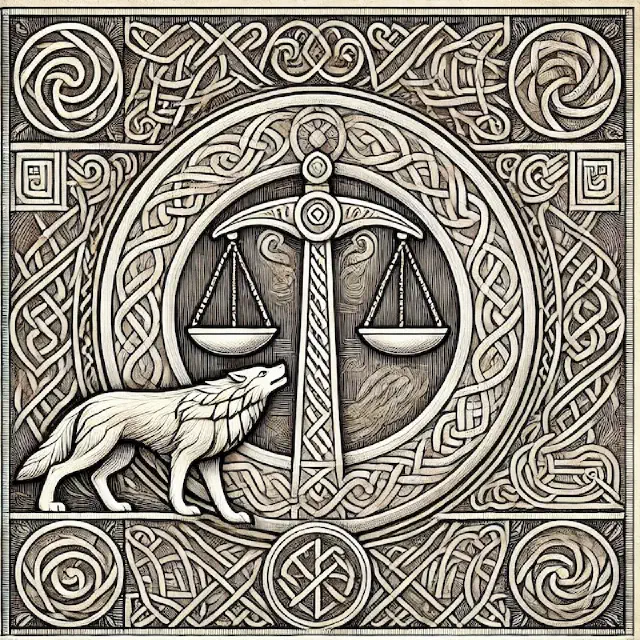
- Name: tiwaz – the god Týr, the sky god
- Sound: t
- Ætt: Týr’s ætt, 1st rune
- Keywords: law, justice, self-sacrifice, troth, discipline
The Name
The Proto-Germanic tiwaz is the name of the god Týr, and the rune opens the third ætt, which bears his name. The word is related to Greek Zeus and Latin Jupiter. The cognates are Gothic teiws, Old English tir (the god, called Tiw in English, but also the ordinary word for “glory”) and Old Norse Týr.
The shape of the stave is read as the vault of the heavens held up by a single column, and sometimes as a spear point.
The Rune Poems
Three medieval poems preserve the lore of the runes, one stanza per rune. The Old English poem speaks of a sign that keeps faith; the two Norse poems speak of the god himself.
Old English Rune Poem (8th–9th century)
Tir biþ tacna sum, healdeð trywa wel
wiþ æþelingas; a biþ on færylde
ofer nihta genipu, næfre swiceþ.Tir is one of the signs; it keeps faith well
with princes; it is always on its course
over the mists of the night, and never fails.
Old Norwegian Rune Rhyme (12th–13th century)
Týr er æinendr ása;
opt værðr smiðr blása.Týr is the one-handed among the gods;
often the smith has to blow.
Old Icelandic Rune Poem (15th century)
Týr er einhendr áss
ok ulfs leifar
ok hofa hilmir.
Mars – tiggiTýr is the one-handed god,
and what the wolf left over,
and the ruler of temples.
Mars – lord
The Old English “sign” that never leaves its course over the night is read as a star—for Thorsson, the Pole Star, around which all other stars turn. The “leavings of the wolf” is Týr himself: in the myth he gave up his hand between the jaws of the Fenris wolf to save the other gods from destruction. The Norwegian line about the smith at his bellows is obscure.
Meaning
Tiwaz is the rune of law. Týr rules over the thing, the assembly where disputes were judged, and he measures out justice according to the law. In the myth he gives up his own hand to protect the other gods, so Tiwaz is also the rune of sacrifice for a greater good, of duty, discipline and keeping one’s word.
The old Northmen also saw battle as a kind of judgement, and Týr was called on for victory—victory that is just and earned. In the cosmos, Tiwaz is the column that holds heaven and earth apart and keeps the world in order, and the fixed star that does not move while everything else turns.
- In balance: troth, justice, clear reasoning, self-sacrifice, careful analysis
- Out of balance: mental paralysis, overthinking, too much sacrifice, injustice, imbalance
Galdr
Galdr is the sung or chanted form of a rune. A traditional pattern for Tiwaz, sung slowly on one long breath per line:
tiwaz tiwaz tiwaz
tiiiiirrrrr
tu ta ti te to
tur tar tir ter tor
ot et it at ut
(Týr Týr)
tiiiiirrrrr
The classic stadha (static rune posture) for Tiwaz is simple: stand straight and let both arms slant down and away from the body, palms facing the ground. The spine becomes the shaft of the stave and the arms its two sloping strokes, like an arrowhead pointing up. The Dynamic Stance of Tiwaz turns this shape into a flowing movement.
Related Runes
- Berkana – the rune that follows it; together they pair a sky god with an earth goddess, the transcendent with the immanent.
- Sowilo – both are guiding lights: the sun travels its circular path, while the star of Tiwaz stays fixed and calm.
- Ansuz – the still, detached wisdom of Týr at the centre of things, set against the wide-ranging, many-sided mind of Odin.