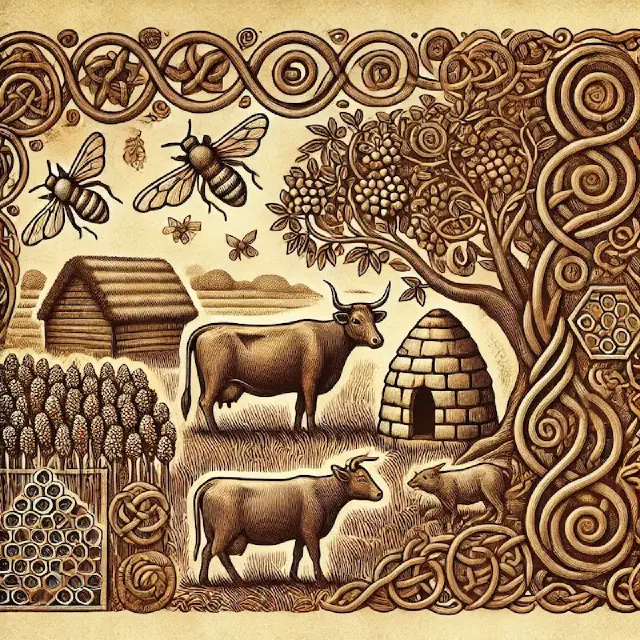
- Name: jera – year, good harvest
- Sound: j (as y in yard)
- Ætt: Hagal’s ætt, 4th rune
- Keywords: reward, harvest, cycle, right timing, plenty
The Name
The Proto-Germanic jera meant the year, and especially the good year that ends in a harvest. Gothic jer and Old English ger mean year; Old Norse ár means year or good season. In the Norse languages the initial j dropped away after about 600 CE, so the younger rune ár stands for the sound a.
The old Germanic year had two halves, summer and winter, and Jera belongs to the summer half, when crops are sown, grown and brought in. Its two hooked strokes are read as the turning of those two seasons, or as the marriage of heaven and earth.
The Rune Poems
All three poems treat the good year as a blessing shared by everyone, from the great to the poor.
Old English Rune Poem (8th–9th century)
Ger byþ gumena hiht, ðonne God læteþ,
halig heofones cyning, hrusan syllan
beorhte bleda beornum ond ðearfum.The harvest year is what people hope for, when God,
heaven’s holy king, lets the soil yield
its bright produce to the great and the poor alike.
Old Norwegian Rune Rhyme (12th–13th century)
Ár er gumna góðe;
get ek at ǫrr var Fróðe.A good year is a blessing to men;
I hold that Fróði was open-handed.
Old Icelandic Rune Poem (15th century)
Ár er gumna góði
ok gott sumar
ok algróinn akr.
annus – allvaldrA good year is a blessing to men,
and a fine summer,
and a field grown full.
year – sovereign
Fróði is the legendary Danish king whose reign was remembered as the “Peace of Fróði”, a golden age of peace and plenty; Thorsson suggests he may be another name of the god Freyr, to whom the Norse sacrificed “for a good year and peace”. The manuscripts of the Icelandic poem differ in its second and third lines, but every reading speaks of a rich season.
Meaning
Jera is reward: the harvest that comes after a cycle of work done according to natural law. A seed does not ask who planted it or why, only how it was planted. If the sowing was done well and at the right time, the reaping will be good. There is no moral judgement in this; it is simply how the cycle works.
The heart of the rune is the cycle itself—arising, growing, passing away and arising again. Results come in their season and cannot be forced. Jera teaches patience, right timing and trust in a process that returns.
- In balance: reward, plenty, peace, right timing
- Out of balance: repetition without progress, bad timing, poverty, conflict
Galdr
Galdr is the sung or chanted form of a rune. A traditional pattern for Jera, sung slowly on one long breath per line:
jera jera jera
jjjjeeeerrrraaaa
jjjjjjjjjj
ju ja ji je jo
(jur jar jir jer jor)
jjjjeeeerrrraaaa
The classic stadha (static rune posture) for Jera uses both arms bent at the same angle: the right hand rises so that its thumb touches the crown of the head, and the left hand drops so that its fingertips rest on the left hip bone. The two arms echo the two hooks of the stave. The Dynamic Stance of Jera turns this shape into a flowing movement.
Related Runes
- Eihwaz – together they form the core pair at the centre of the row: Jera is the turning millstone of the year, Eihwaz the axis it turns on.
- Raidho – Raidho is the sun’s daily path, Jera its yearly round.
- Ingwaz – the seed-force of the god Ing, released to give the plentiful year.