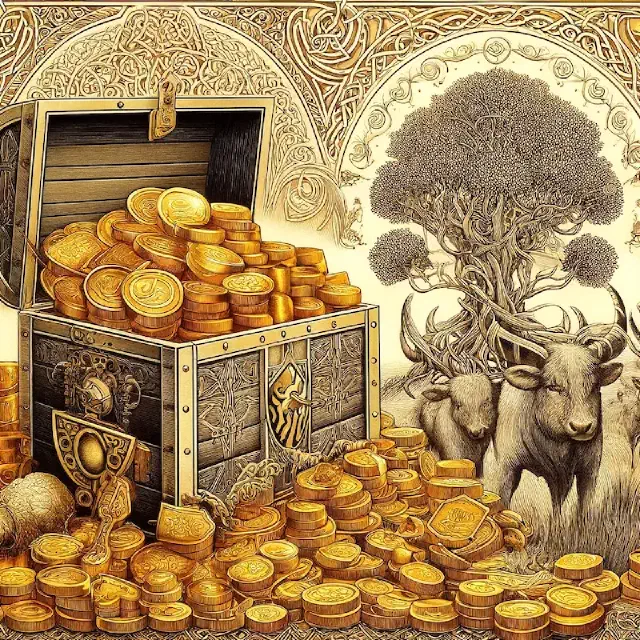
- Name: fehu – cattle, livestock, mobile wealth
- Sound: f
- Ætt: Freyr’s ætt, 1st rune
- Keywords: mobile wealth, circulation, beginning, fire
The Name
The Proto-Germanic fehu meant movable property. Because livestock was the main form of wealth that could move, the word came to mean cattle, and later money: Gothic faíhu, Old English feoh, Old Norse fé. Modern English still carries it in the word fee.
Fehu is wealth that moves—it can be traded, given, lost or increased—unlike Othala, the inherited land that stays with the family.
The Rune Poems
Three medieval poems preserve the lore of the runes, one stanza per rune. All three speak of Fehu as wealth, and all three warn about what wealth does when it stops flowing.
Old English Rune Poem (8th–9th century)
Feoh byþ frofur fira gehwylcum;
sceal ðeah manna gehwylc miclun hyt dælan
gif he wile for drihtne domes hleotan.Wealth is a comfort to everyone;
yet each must share it out freely
who wishes to win honour before the lord.
Old Norwegian Rune Rhyme (12th–13th century)
Fé vældr frænda róge;
føðesk ulfr í skóge.Wealth causes strife among kinsmen;
the wolf is raised in the forest.
Old Icelandic Rune Poem (15th century)
Fé er frænda róg
ok flæðar viti
ok grafseiðs gata.
aurum – fylkirWealth is the strife of kinsmen,
and the fire of the flood,
and the path of the serpent.
gold – chieftain
The “fire of the flood” and the “path of the serpent” are kennings for gold: it gleams like fire under water, and it is the bed of the dragon that guards a hoard. The Norwegian line about the wolf is a riddle-like comment: what is hoarded and fought over turns wild.
Meaning
Fehu stands at the very beginning of the futhark, and it is the rune of beginnings: the first spark, the first resources, the start of a new path. In the lore it is tied to fire and to the gods whose names share its sound—Freyr, Freyja and Frigg.
The core of Fehu is circulation. Wealth, energy and luck increase when they move and are given forward with foresight; held tight, they stagnate and breed conflict. The Old English poem’s call to share and the Norse poems’ warning about strife are two sides of the same idea.
- In balance: prosperity, social success, foresight, generosity, a fresh start
- Out of balance: greed, burnout, stagnation, poverty, quarrels over property
Galdr
Galdr is the sung or chanted form of a rune. A traditional pattern for Fehu, sung slowly on one long breath per line:
fehu fehu fehu
ffffffffff
fu fa fi fe fo
of ef if af uf
ffffffffff
The classic stadha (static rune posture) for Fehu has both arms raised at an angle, one slightly higher than the other, like the two branches of the stave. The Dynamic Stance of Fehu turns this shape into a flowing movement.
Related Runes
- Othala – inherited, immovable wealth, the counterpart to Fehu’s mobile wealth.
- Dagaz – the last rune of the row in many orderings; Fehu begins the cycle, Dagaz completes it and returns to a new beginning.