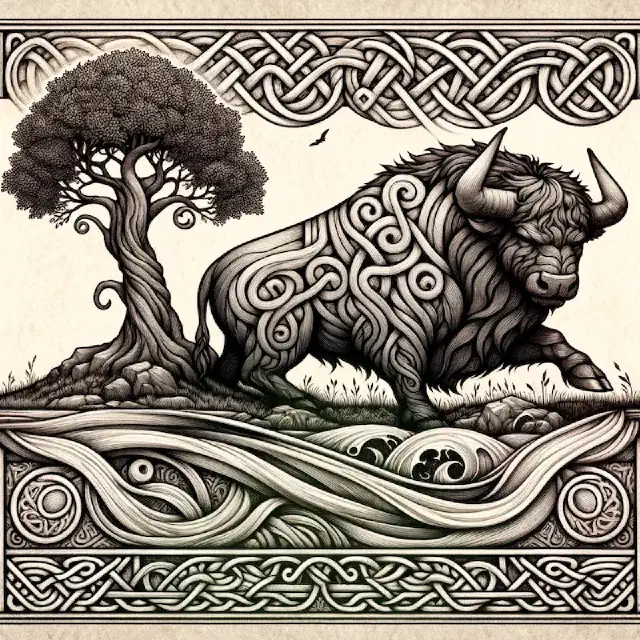
- Name: uruz – aurochs, the great wild ox
- Sound: u
- Ætt: Freyr’s ætt, 2nd rune
- Keywords: freedom, vital strength, health, the force of formation
The Name
The Proto-Germanic uruz was the aurochs, the huge wild cattle of ancient Europe, now extinct. It was the largest and fiercest beast the Germanic peoples knew, and hunting it was a test of a young man’s strength. Gothic úrus means the same animal, and Old English úr an ox or bison. In Old Norse the word úr came to mean drizzle or rain, and also slag.
Uruz and Fehu belong together: both are named after cattle, but Fehu is the tame herd and Uruz is the untamed animal of the wilderness.
The Rune Poems
All three poems have a stanza for Uruz, but only the Old English one still speaks of the aurochs.
Old English Rune Poem (8th–9th century)
Ur byþ anmod ond oferhyrned,
felafrecne deor, feohteþ mid hornum
mære morstapa; þæt is modig wuht.The aurochs is proud and high-horned,
a fierce and perilous beast, it fights with its horns,
a mighty walker of the moors; it is a spirited creature.
Old Norwegian Rune Rhyme (12th–13th century)
Úr er af illu jarne;
opt løypr ræinn á hjarne.Dross comes from poor iron;
often the reindeer races over the crusted snow.
Old Icelandic Rune Poem (15th century)
Úr er skýja grátr
ok skára þverrir
ok hirðis hatr.
umbre – vísiDrizzle is the weeping of clouds,
and the spoiler of the mown hay,
and the herdsman’s hatred.
shower – leader
The Norse poems use úr in its later senses: slag forced out of poor iron, and rain forced out of a cloud. Rain is usually welcome, but when it falls on hay that has been cut and left to dry, the harvest is ruined—hence the herdsman’s hatred. The Latin word umbre (“shadow”) in the Icelandic manuscript is generally taken as a slip for imber, “shower”.
Meaning
Uruz is the wild, untamed life force: raw strength, vitality, health and good condition of the body. Where Fehu is wealth that people tend and trade, Uruz cannot be owned. It is a force that has to be met, tested and earned.
In the lore Uruz is tied to Audhumla, the primeval cow of the creation myth, and it is the rune of formation: the drive that orders raw substance into living, organic shapes. Uruz is the shaping force rather than the finished form. Because of this it also stands for health in a person and for living tradition in a community. Spent without wisdom or in the wrong direction, the same vital force turns destructive.
- In balance: strength, protection, tenacity, freedom, form, health, understanding
- Out of balance: weakness, obsession, misdirected force, domination by others, illness, inconsistency, ignorance
Galdr
Galdr is the sung or chanted form of a rune. A traditional pattern for Uruz, sung slowly on one long breath per line:
uruz uruz uruz
uuuuuuuuuu
uuuuurrrrr
uuuuuuuuuu
The classic stadha for Uruz is a deep forward bend: the back level with the ground, arms and fingertips hanging straight down, so the body makes the downward-opening shape of the stave. The Dynamic Stance of Uruz turns this shape into a flowing movement.
Related Runes
- Fehu – tame and wild: the domestic herd beside the untamed aurochs.
- Dagaz – gradual transformation, step by step and according to an order, beside the organic, self-driven transformation of nature in Uruz.