- Name: thurisaz – the strong one, giant
- Sound: th (as in thorn)
- Ætt: Freyr’s ætt, 3rd rune
- Keywords: regeneration, will, applied force, defence
The Name
The Proto-Germanic thurisaz means “the strong one”: a thurs, one of the primal giants known for brute strength rather than wit. Old Norse keeps the name as þurs, giant. The Old English rune name is þorn, a thorn, and the Gothic letter name is thiuth, “the good one”.
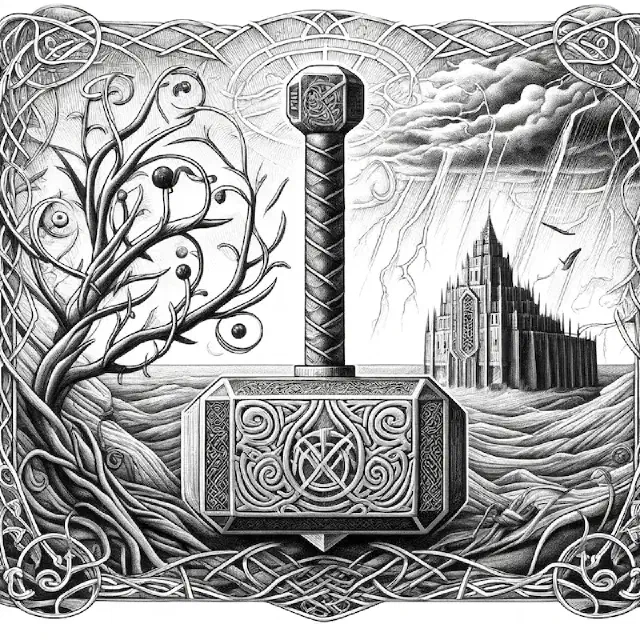
The rune belongs both to the giants and to the god who fights them. Thor, with his hammer Mjölnir, matches the giants’ raw strength with his own and guards the worlds of gods and humans against them.
The Rune Poems
All three poems have a stanza for Thurisaz, and all three describe something that hurts.
Old English Rune Poem (8th–9th century)
Ðorn byþ ðearle scearp; ðegna gehwylcum
anfeng ys yfyl, ungemetum reþe
manna gehwylcum, ðe him mid resteð.The thorn is very sharp; for any thane
to take hold of it is bad, and beyond measure cruel
to any man who lies down among them.
Old Norwegian Rune Rhyme (12th–13th century)
Þurs vældr kvinna kvillu;
kátr værðr fár af illu.The giant brings sickness on women;
few grow merry from misfortune.
Old Icelandic Rune Poem (15th century)
Þurs er kvenna kvöl
ok kletta búi
ok varðrúnar verr.
Saturnus – þengillThe giant is women’s torment,
and a dweller among the cliffs,
and the husband of Varðrún.
Saturn – prince
The Old English poet turns the rune into a thorn bush, and draws a line between the warrior who grasps the thorns and the ordinary man who merely lies among them. The Norse poems keep the older name: the þurs is a giant who harms women, and Varðrún is a giantess, his wife (the manuscript is damaged at this word, so the name is partly conjectured).
Meaning
Thurisaz is directed force: the will in its raw, instinctive form, without self-reflection. It is the force of destruction and defence, the lightning and Thor’s hammer that strike down what threatens order. Like a thorn that protects the rose, it defends by being able to wound.
The rune is also one of regeneration. As lightning comes before the rain that brings the crops, Thurisaz breaks down barriers so that something new can begin. Thorsson describes it as Fehu and Uruz combined—fiery energy given a shape and a direction. The same force that clears the way can also become a danger when no one directs it.
- In balance: reactive force, focused force, vital sensuality, a catalyst for regeneration
- Out of balance: danger, defencelessness, compulsion, betrayal, dullness
Galdr
Galdr is the sung or chanted form of a rune. A traditional pattern for Thurisaz, sung slowly on one long breath per line:
thurisaz thurisaz thurisaz
th th th th th th th th th th
thur thar thir ther thor
thu tha thi the tho
th th th th th th th th th th
The classic stadha for Thurisaz is an upright stance with the left arm bent and the hand resting on the hip bone; the straight body is the stave and the bent arm its thorn. The Dynamic Stance of Thurisaz turns this shape into a flowing movement.
Related Runes
- Ingwaz – maturing and slow growth, beside the sudden regeneration of Thurisaz.
- Ansuz – both are powers greater than human; Thurisaz is the blind force of nature, Ansuz the conscious force of the gods.