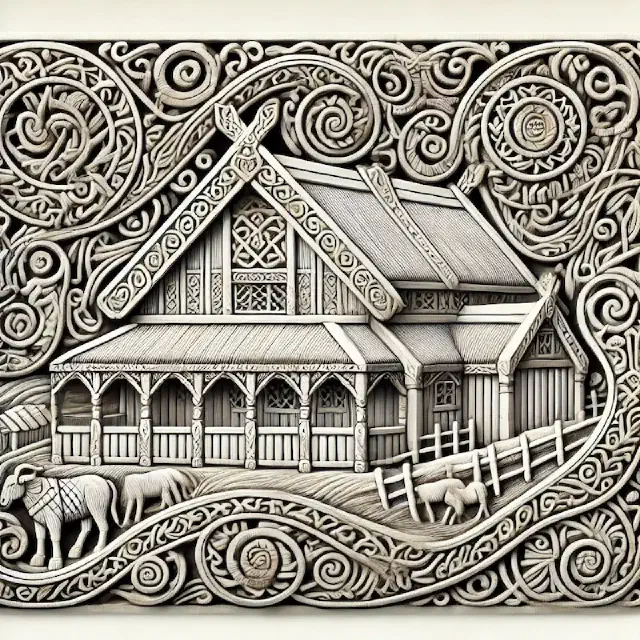
- Name: othala – ancestral property, inherited land
- Sound: o
- Ætt: Týr’s ætt, 8th rune
- Keywords: home, inheritance, kin, sacred enclosure, freedom
The Name
The Proto-Germanic othala means ancestral property: land that belongs to a family across the generations. The cognates are Gothic othal (property), Old English eþel (homeland, property) and Old Norse óðal, which meant both property and inborn nature, the qualities one is born with. The rune was not kept in the younger, sixteen-rune row.
Othala is wealth that stays—it cannot be carried off or sold out of the kin—unlike Fehu, the wealth that moves.
Sources differ on the order of the last two runes: the Old English poem puts Othala before Dagaz, while Thorsson, citing the Kylver stone, takes Dagaz–Othala as the original order. This site follows Thorsson, so Othala is the 24th and last rune of the row.
The Rune Poems
Only the Old English poem has a stanza for Othala; the two Norse poems follow the younger row, which no longer had this rune.
Old English Rune Poem (8th–9th century)
Eþel byþ oferleof æghwylcum men,
gif he mot ðær rihtes and gerysena on
brucan on bolde bleadum oftast.A homeland is very dear to every man,
if there in his house he may enjoy
what is right and fitting, most often in plenty.
The stanza ties love of home to two conditions: that life there is lawful and fitting, and that it is prosperous. Othala is not just a piece of land but a place where right order holds.
Meaning
Othala is the rune of home: the enclosed land of the kin, set apart from what lies outside it and made sacred. In Norse lore this is Midgard, “the enclosure in the middle”. The boundary works as a selective wall: it keeps out what would harm the inside and lets in what is good for it.
Othala is also what we inherit—not only land but the qualities, skills and spirit handed down through a family, its legacy. It is managed wisely and justly by those who hold it, for the good of the whole group, and it gives freedom inside a secure and lawful community. Through marriage, people from outside can join the kin and share in it.
- In balance: home, shared prosperity, order in the group, freedom, productive cooperation
- Out of balance: lack of settled order, tyranny, slavery, poverty, homelessness
Galdr
Galdr is the sung or chanted form of a rune. A traditional pattern for Othala, sung slowly on one long breath per line:
othala othala othala
oooooooooo
ooooo
othul othal othil othel othol
othol othel othil othal othul
ooooo
The classic stadha (static rune posture) for Othala combines a wide stance with closed arms. Stand with the legs spread wide, as the two lower strokes of the stave, and bring the fingertips together so that the arms form the closed angle above: low, just in front of the groin, when you want to bring your will into being, or high above the head for work that seeks inspiration. The Dynamic Stance of Othala turns this shape into a flowing movement.
Related Runes
- Fehu – mobile wealth against immovable wealth: Fehu is what circulates, Othala what is inherited and stays with the kin.
- Dagaz – its partner rune; both are about limits and borders, Dagaz those of the sky and of time, Othala those of the earth and of space.