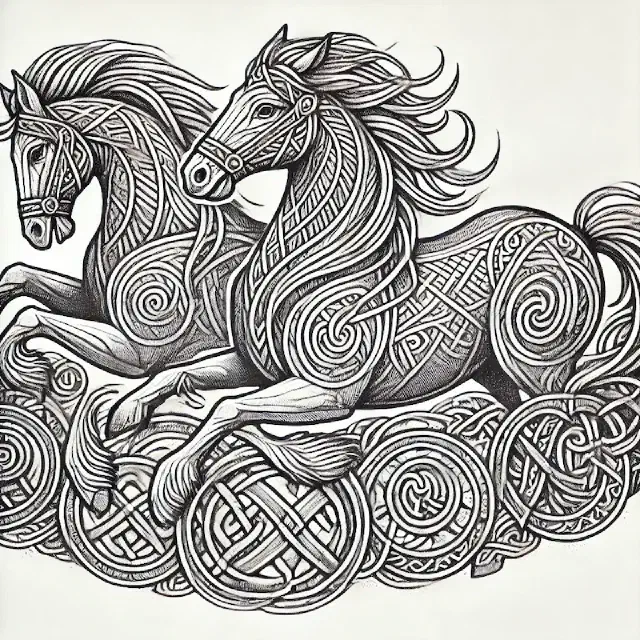
- Name: ehwaz – horse (or ehwo, the two horses)
- Sound: e
- Ætt: Týr’s ætt, 3rd rune
- Keywords: partnership, teamwork, trust, loyalty, harmony
The Name
The Proto-Germanic ehwaz means “horse”, related to Latin equus; the form ehwo means “the two horses”. The cognates are Gothic aíhws (stallion), Old English eh (war horse) and Old Norse jór (horse), a word used only in cultic contexts. The rune was not kept in the younger, sixteen-rune row.
The shape of the stave is read as two upright poles bound together, a sign of the divine twins, or as two horses facing one another.
The Rune Poems
Only the Old English poem has a stanza for Ehwaz; the two Norse poems follow the younger row, which no longer had this rune.
Old English Rune Poem (8th–9th century)
Eh byþ for eorlum æþelinga wyn,
hors hofum wlanc, ðær him hæleþ ymb[e]
welege on wicgum wrixlaþ spræce
and biþ unstyllum æfre frofur.The horse is the joy of princes in the sight of warriors,
a steed proud in its hooves, where heroes around it,
wealthy men on horseback, exchange their words;
and to the restless it is always a comfort.
The stanza shows the horse as a sign of rank and pride, the centre of a gathering of riders. The last line calls it a comfort to “the restless”—those who cannot stay in one place.
Meaning
Ehwaz is the rune of the team: two different beings who work together toward one goal, such as rider and horse, horse and chariot, body and soul. It is about partnership and the trust and loyalty that make it work. The bond between a rider and a good horse is the clearest example, and the rune is also a sign of lawful marriage. An old Norse saying puts it simply: marr er manns fylgja, “the horse is a man’s fetch”—his companion spirit.
The horse was a symbol of status, much as a car is today. It is also the vehicle of journeys between the worlds: Ehwaz is the rune of Sleipnir, Odin’s eight-legged steed, on which the rune worker travels through the realms of Yggdrasil.
- In balance: harmony, teamwork, trust, loyalty
- Out of balance: duplicity, discord, mistrust, betrayal
Galdr
Galdr is the sung or chanted form of a rune. A traditional pattern for Ehwaz, sung slowly on one long breath per line:
ehwo ehwo ehwo
eeeehwooooo
ehwu ehwa ehwi ehwe ehwo
ehwo ehwe ehwi ehwa ehwu
eeeehwooooo
You can also try the same pattern with the singular form, ehwaz.
The classic stadha (static rune posture) for Ehwaz suits a rune of partnership: two people, often a man and a woman, stand facing each other, each leaning in with arms stretched out and slanting down, so that together they form the stave. Alone, you can stand straight with one arm slanting up and the other down. The Dynamic Stance of Ehwaz turns this shape into a flowing movement.
Related Runes
- Mannaz – horse and human, the rune that follows it. The horse brings strength, speed and movement; the human brings thought, guidance and purpose. Combined, e and m spell em, “I am”.
- Thurisaz – the contrasting case: Thurisaz holds two opposed extremes and drives them into one directed action, where Ehwaz joins two willing partners.