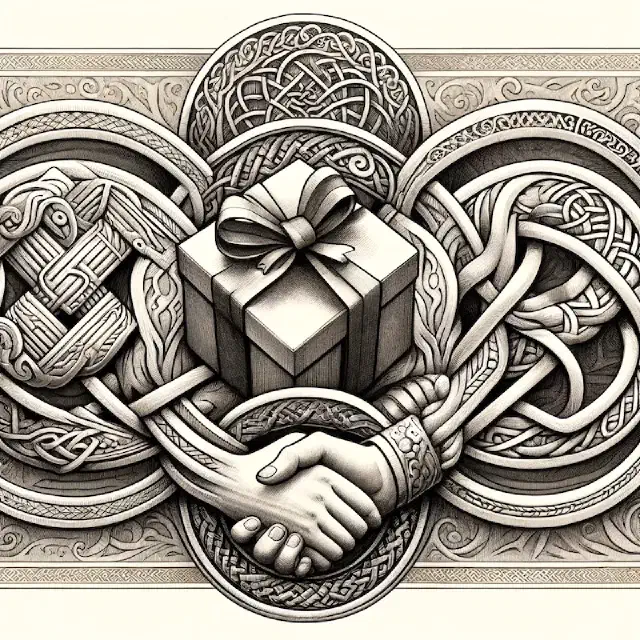
- Name: gebo – gift, hospitality
- Sound: g (as in gift)
- Ætt: Freyr’s ætt, 7th rune
- Keywords: exchange, gift, hospitality, sacrifice
The Name
The Proto-Germanic gebo means a gift and the hospitality that goes with it. Gothic giba is a gift, Old English gyfu a gift or generosity, and Old Norse gipt a gift or a wedding. Modern English still has it in gift. The rune itself did not survive into the Younger Futhark used in Viking-age Scandinavia.
The shape of the stave is two beams crossing, as in the frame of a building: two forces that meet and hold each other.
The Rune Poems
Only the Old English poem has a stanza for Gebo; the Norse poems follow the shorter Younger Futhark, which no longer has this rune.
Old English Rune Poem (8th–9th century)
Gyfu gumena byþ gleng and herenys,
wraþu and wyrþscype and wræcna gehwam
ar and ætwist, ðe byþ oþra leas.For men, giving is an ornament and a praise,
a support and an honour; and for every outcast
it is help and a living, when he has nothing else.
The stanza shows both sides of a gift: it brings honour to the one who gives, and it keeps alive the one who has nothing.
Meaning
Gebo is the rune of exchange: giving and receiving a gift, hospitality and sharing, sacrifice and marriage. A gift in the old sense was never one-way. It called for a gift in return, and this exchange built strong bonds between people, and between people and the gods: humans give to the gods, and the gods give back.
Thorsson calls Gebo the giver, the giving, the given and the one given to, all at once. In the myth it is the gift of Odin to humankind—consciousness, breath and form. Between two people it is the bond that makes them together more than the sum of the two.
- In balance: the gift and giving, generosity, magical exchange, honour, sacrifice
- Out of balance: buying influence, greed, loneliness, dependence, excessive sacrifice
Galdr
Galdr is the sung or chanted form of a rune. A traditional pattern for Gebo, sung slowly on one long breath per line:
gebo gebo gebo
gu ga gi ge go
gub gab gib geb gob
og eg ig ag ug
The classic stadha for Gebo is a wide stance with the feet pointing forward and the knees straight, the arms raised out to the sides so that the body forms an X, each hand directly above the foot on the same side. The Dynamic Stance of Gebo turns this shape into a flowing movement.
Related Runes
- Wunjo – the outer exchange of gifts and the inner joy that answers it.
- Ansuz – both are runes of ecstasy and of the gifts of the gods to humankind.